
Table.Briefings Africa, 19 June 2026.
In 1994, Time magazine described UNHCR as the “jewel in the crown” of the United Nations, reflecting the agency’s prestige after two Nobel Peace Prizes and the strong leadership of Sadako Ogata. Under her tenure, the UN Refugee Agency became a multi-billion-dollar humanitarian organization.
Today, however, the UN Refugee Agency is facing a crisis, and not just another one of its cyclical budgetary pressures. The most important trigger has been the shift in US policies, especially the repurposing of the Bureau of Population, Refugees, and Migration (BPRM) in the US State Department. For decades, this office anchored UNHCR funding and oversight, covering up to two-thirds of the agency’s budget. Its dismantling signals a sharp turn towards repatriation and deportation policies, not only in the US, but globally.
The effects have not been limited to Washington: Other donor governments, such as Germany, have followed suit, creating a broader financial collapse, while China and major oil-producing states have failed to fill the gap.
Financial problems are compounded by a decline in adherence to international law. That has become evident with regard to the laws of armed conflict and is also seen in asylum and refugee policies. In many corners of the world, a race to the bottom in refugee protection is underway. In the Global South, however, states such as South Africa are engaged in legal and diplomatic resistance through initiatives such as the Hague Group. This demonstrates that, even if not resulting in greater funding for humanitarian purposes, international legality still matters to weaker states also.
Against this backdrop, the UN Secretary-General has launched the UN80 reform process, and the UN Refugee Agency must now confront an uncomfortable truth: Its current structure may no longer be sustainable. UNHCR’s mandate is rooted in the 1951 Refugee Convention, but that legal framework covers only parts of today’s displacement reality. Millions of forcibly displaced people fall outside its direct scope, such as Palestinians (who fall under UNRWA), internally displaced persons (IDPs), and migration movements caused by climate change and occupation, or by other events seriously disturbing public order.
In today's constrained environment, a holistic approach to forced displacement is needed. At the same time, the original logic of the UNHCR Statute suggests that the agency was never intended to replace governments. Therefore, paternalism should be replaced by subsidiarity. Protection and assistance is provided on the ground. Consequently, the UN Refugee Agency should prioritize the strengthening of local capacities over direct operational involvement. Innovative approaches and collaboration with partners, such as the International Organization for Migration (IOM), could lead to the recognition that investing in labor migration pathways can complement traditional refugee resettlement, thereby expanding the options for durable solutions.
The 1950 UNHCR Statute already emphasized the important role of the private sector in refugee protection and welfare. Nowadays, it is widely accepted that corporations and civil society are key partners in innovation, technical expertise and scaling. Fortunately, in some countries the UNHCR already has a robust network of partners that are embedded within their societies. The principle of subsidiarity is paramount here as well. Not only can locally anchored NGOs assist refugees efficiently, they can also mobilize civil society for financial contributions. A case in point is España con ACNUR (Spain), which contributed $110 million to UNHCR’s budget in 2025. Pledged contributions across the full network of national partners for 2026 total around $350 million, mobilizing 1.7 million “high street donors.” Likewise, the millions of volunteers of the Red Cross/Crescent movements and of other NGOs are indispensable resources for the refugee cause.
However, for this to happen, the UN Refugee Agency must start treating its national and civil society partners as equals. Unfortunately, their potential remains largely untapped due to institutional habits that favor centralization and hierarchy. The outcome of UN80 is still uncertain, but the direction is clear. Turf battles, as we saw during the 2005 Humanitarian Reform process, will not save the day. Instead, we need task-sharing and collaboration, not inter-agency competition. UNHCR can no longer rely on the prestige it earned in a bygone era. In a world of limited resources and growing displacement, the agency’s future depends on it becoming a building block within an effective, sustainable structure that protects and assists refugees while upholding international law rather than remaining a shining but solitary jewel.
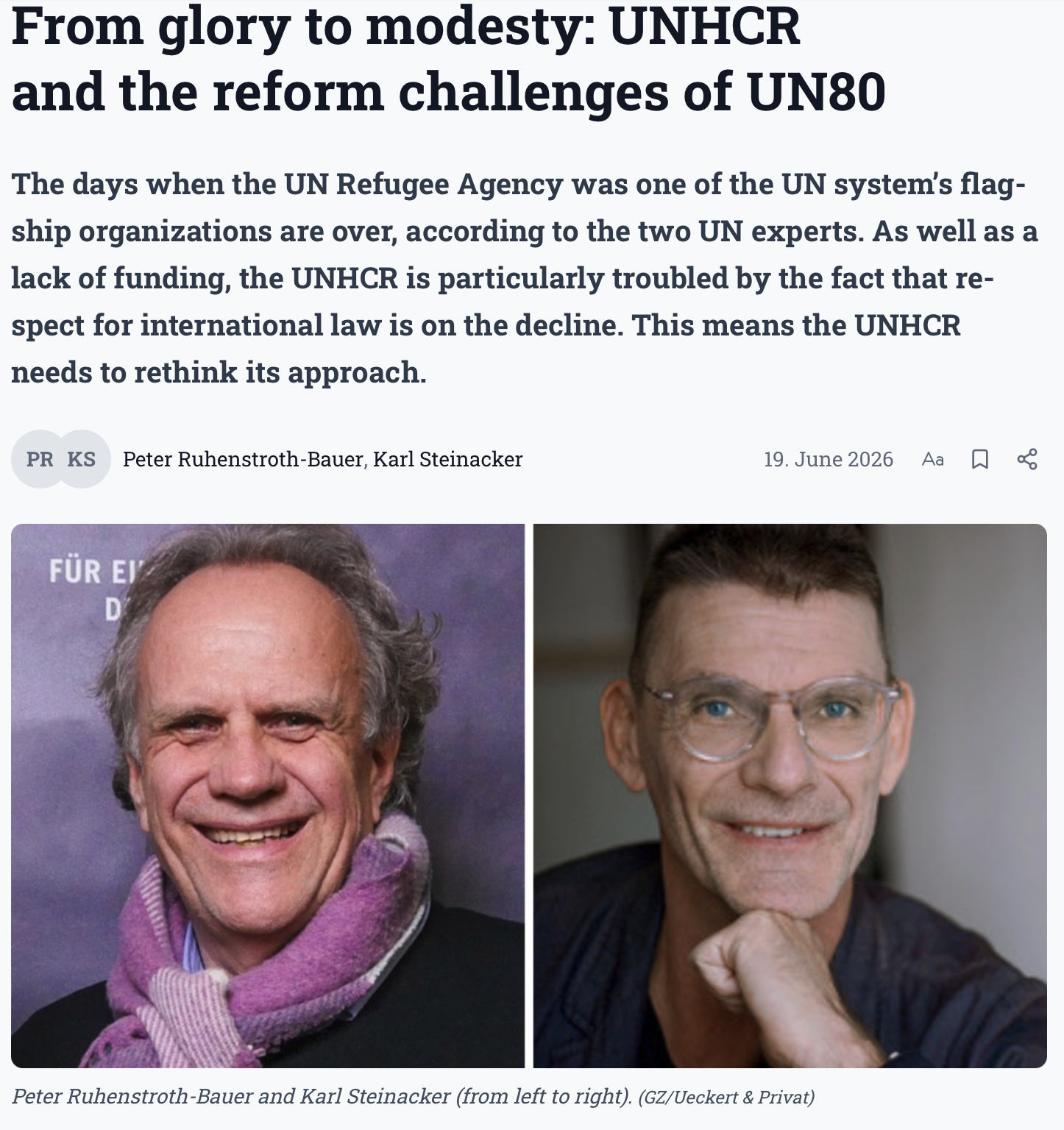
Peter Ruhenstroth-Bauer (SPD) served as National Director of UNO-Flüchtlingshilfe, the German partner organization of the UNHCR, from 2017 to 2025. Prior to that, the lawyer was actively involved at the intersection of politics, business, and civil society – including as State Secretary in the Ministry of Family Affairs under the leadership of Renate Schmidt.
Karl Steinacker worked in various UN organizations, starting with the UNDP, before assuming leadership roles at the UNHCR. In the area of cross-organizational cooperation, he played a key role in establishing the Camp Coordination and Camp Management (CCCM) cluster, among other initiatives.
In today’s environment, discussion inevitably involves controversial debates. Our goal is to present various perspectives, providing you with comprehensive insight into the breadth of current discourse.
Opinion pieces reflect the views of their authors and do not necessarily represent those of the editorial team.
Last updated: 19. June 2026
Link to the original article: Click here